
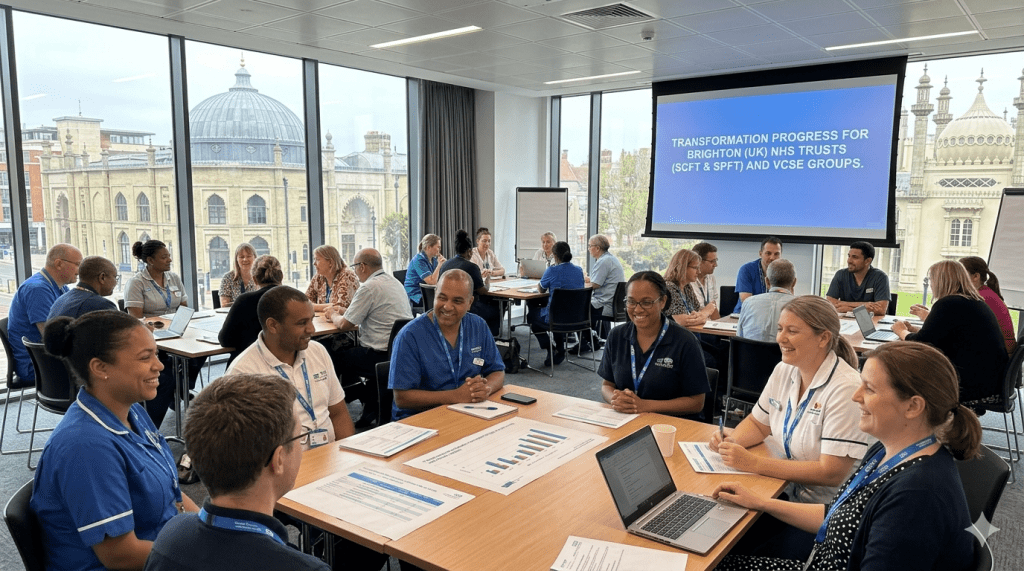
April Briefing: Transformation Progress for Brighton (UK) NHS Trusts (SCFT & SPFT) and VCSE Groups
Date: Thursday, 9 April 2026
Focus: Tracking integration, service redesign, community mental health shifts, and related developments involving Sussex Community NHS Foundation Trust (SCFT), Sussex Partnership NHS Foundation Trust (SPFT), and Voluntary, Community & Social Enterprise (VCSE) partners in the Sussex Integrated Care System (ICS), with emphasis on Brighton & Hove.
This briefing summarises key ongoing transformations under frameworks like Improving Lives Together, the Major Service Review (MSR) for new care models, Neighbourhood Mental Health Teams (NMHTs), and Integrated Community Teams (ICTs). It highlights progress, persistent issues/concerns, and resolutions where evident. Information draws from official NHS Sussex, trust, and partner sources (as of early 2026 updates).
1. Community Mental Health Transformation (Primary Focus: SPFT-led with VCSE Integration)
Overview: Sussex is shifting from fragmented services to 15 Neighbourhood Mental Health Teams (NMHTs) for adults and older adults.
These integrate primary care, specialist mental health (SPFT), VCSE emotional wellbeing/support services, local authorities, and social care for person-centred, community-based support closer to home.
Goals include reducing waiting times, duplication, inpatient admissions, and addressing rising demand/complexity post-pandemic.
Brighton & Hove Specifics: Three NMHTs cover West Brighton & Hove, Central Brighton, and East Brighton, aligned with local Integrated Community Team footprints.
Consultations shaped geographical areas; co-production involves lived experience groups (e.g., via Possability People).
Progress:
- NMHTs formally launched 8 December 2025; core elements implemented across Sussex, with ongoing rollout of functions (e.g., specialist adults, older adults).
- Emotional Wellbeing Service (VCSE-involved) live in GP surgeries for short-term support.
- Access Facilitators for Severe Mental Illness (SMI) patients to improve physical health checks (addressing 15-20 year life expectancy gap).
- Enhanced Community Rehabilitation Service expanded (partnerships, e.g., with groups like West Sussex Mind or BHT Sussex in related areas).
- Shared electronic patient records with VCSE for better joint working; monthly webinars and newsletters continue (e.g., Brighton/Hove-focused sessions).
- SPFT’s 2025–2030 strategy emphasises data sharing, digital-first approaches, and partnerships.
VCSE Role: Strong collaboration from the start—VCSE leads contributed to NMHT standards, co-design, and delivery.
Dedicated roles funded; Sussex VCSE Mental Health Network influences service shaping.
Examples include crisis cafes in Staying Well services and Recovery Colleges.
Open dialogue noted as positive.
Issues/Concerns & Resolution Tracking:
- Rising demand & waiting times: Urgent/emergency referrals up significantly; variation in access (historical commissioning differences, workforce issues).
- Progress via NMHTs and “left shift” to community prevention; CAMHS transformation (new Thrive-aligned model Q1 2026/27) and ADHD pilot launching March 2026 in Brighton & Hove (triage/digital pathways for ~6,000 people aged 16+).
- Fragmentation & navigation issues: Addressed through “no wrong door” model, reduced duplication, and multi-agency teams.
- NMHT Standard Operating Procedures and communication guidelines issued (2025).
- Inpatient/crisis pressures: High 12-hour ED breaches; out-of-area placements.
- Mitigations include Rapid Response service (avoided 991 Section 136 detentions and 8,500+ ED attendances in 2025), Staying Well services (7,000+ supported), and reduced Delayed Transfers of Care (CRFD from 25% to 14%).
- Housing support initiative (SPFT specialists embedded) dramatically cut housing-related bed days (from 1,010 in 2023 to <1% by late 2025); Brunswick ward in Brighton repurposed for acute adult use.
- Inequalities: Persistent in access/outcomes (ethnicity, deprivation, Core20PLUS5 groups).
- Targeted actions in Brighton & Hove; data completeness improving (protected characteristics recording); PCREF framework in use.
- Neurodiversity pilots (e.g., PINS in schools).
- Governance & safety (SPFT): CQC concerns (e.g., warning notice July 2025 on crisis services; requires improvement ratings in some areas like older adult wards).
- Trusts report “significant improvements” post-inspections; ongoing risk registers and oversight via MHLDA Programme Board (SPFT chairs).
Key References:
- NMHT main page & details: https://www.sussex.ics.nhs.uk/our-work/our-priorities/mental-health-learning-disability-and-autism/mental-health/community-mh-transformation/
- Mental Health Update (Feb 2026): https://www.sussex.ics.nhs.uk/wp-content/uploads/sites/9/2026/02/2.6-Mental-Health-Update.pdf
- SPFT NMHT page: https://www.sussexpartnership.nhs.uk/neighbourhood-mental-health-teams
2. SCFT Community Health & Integrated Neighbourhood Teams
Overview: SCFT focuses on community services (e.g., home-based care, rehabilitation, urgent community response).
Priorities for 2025/26: Integrated Neighbourhood Teams (coordinated proactive care for complex needs), Rehabilitation & Home First, Urgent & Emergency Care, and waiting list management.
Aligns with Sussex MSR for new models of care (Urgent & Emergency, Rehabilitation/Intermediate Care, ICTs).
Brighton Specifics: Plans for a new Community Health and Wellbeing Hub on the Brighton General Hospital site (former East Brighton site redevelopment).
Strategic Case advanced (preferred 6-storey hub option outlined 2025); mixed-use redevelopment includes health facilities alongside potential housing.
Progress: Virtual wards and urgent community response teams active (e.g., treating hundreds at/near home).
Contribution to system-wide ICTs and new care models via MSR steering (clinical co-design with multiple trusts). Climate leadership recognised separately.
Issues/Concerns & Resolution Tracking:
- Workforce, financial sustainability, rising demand (ageing population): Sector-wide; SCFT part of broader ICS risk mitigation through integration and outcomes-based approaches.
- Site redevelopment delays/accessibility: Historic buildings not fit for modern care; steep site challenges noted in older reports. Progress via Strategic Case; campaign calls for public benefit (housing + health) continue into 2026, with MP/council engagement.
- Digital transformation: Ongoing strategy to support care experience.
Key References:
- SCFT 2025/26 Strategic Plan summary: https://www.sussexcommunity.nhs.uk/news/trust-news/sharing-our-strategic-plan-for-2025-26
- Brighton General Hub update (2025): https://www.sussexcommunity.nhs.uk/news/trust-news/plan-for-a-new-brighton-health-hub-moves-forward
- MSR New Models paper (Sep 2025): https://www.sussex.ics.nhs.uk/wp-content/uploads/sites/9/2025/09/3.1-Delivering-Improving-Lives-Together-New-Models-of-Care.pdf (risks include financial/clinical sustainability, stakeholder confidence; mitigations via engagement and modelling).
3. Broader VCSE & System Integration
Overview: VCSE groups are embedded in NMHTs, ICTs, and emotional wellbeing pathways.
Alliances (e.g., East Sussex VCSE Alliance) emphasise strategic voice, collaboration, and addressing sector pressures (funding, spaces).
Partnership Plus Group and health/social care networks in Brighton support joined-up working.
Progress: Co-design and delivery roles in mental health; shared records; thematic networking. “State of the Sector” reports highlight ambitions for core funding, asset compacts, and reduced competition.
Issues/Concerns & Resolution Tracking:
- Financial strain on VCSE and short-term funding models. Shift towards collaborative contracts and social value.
- Need for trust-building and equal partnership. Ongoing via alliances and leadership groups; positive examples in NMHT co-production.
Key References:
- VCSE Spotlight on NMHTs (Jan 2026): https://www.sussexpartnership.nhs.uk/about-us/news-events/blogs/spotlight-vcse-nmhts
- East Sussex VCSE reports: Various via esvcsealliance.org.uk
Overall System Context & Next Steps
Transformations align with NHS Sussex priorities and national neighbourhood health models.
From April 2026, structural changes (e.g., ICB evolution to Surrey and Sussex) may influence governance.
Risks (financial, clinical, engagement) are monitored via boards and strategic risk registers; mitigations centre on co-design, data/digital tools (e.g., SPFT SystmOne EPR), and partnerships.
Watch For: Further NMHT/ICT implementation updates, Brighton Hub planning decisions, CQC follow-ups, and VCSE funding models.
Monthly webinars/newsletters provide granular Brighton insights.
For real-time access, monitor official sites: (sussex.ics.nhs.uk → transitioning to surreysussex.icb.nhs.uk; scft.nhs.uk; sussexpartnership.nhs.uk) and local Healthwatch/scrutiny committees.
This briefing is a snapshot—transformations are iterative with ongoing stakeholder input.
Similar transformations are underway nationally across England (the relevant NHS system for Sussex).
These are not isolated to Sussex but form a core part of the NHS 10 Year Health Plan for England: Fit for the Future (published July 2025) and the national shift from hospital to community-based care. The Sussex model (Neighbourhood Mental Health Teams (NMHTs), Integrated Community/Neighbourhood Teams (ICTs/INTs), VCSE integration, “left shift” to prevention, and joined-up community services) is a direct local implementation of England-wide policy.
National Programme: Neighbourhood Health Service
- Key framework: NHS England’s Neighbourhood Health Guidelines 2025/26 (January 2025) and the Neighbourhood Health Framework (March 2026) set out the national model.
- Core elements (directly mirroring SCFT/SPFT/VCSE work in Brighton & Hove):
- Integrated Neighbourhood Teams (INTs): Multidisciplinary teams (GPs, community health, mental health, social care, VCSE) delivering proactive, personalised care for complex needs (frailty, long-term conditions, mental health, etc.). Footprints ~30,000–50,000 people.
- Neighbourhood mental health: Builds on the 2019 Community Mental Health Framework. Includes expansion of community teams and pilots of 24/7 Neighbourhood Mental Health Centres (as alternatives to inpatient care, providing crisis response, planned care, and overnight support by the same team).
- VCSE and social prescribing fully embedded; population health management; urgent community response / virtual wards / Home First; shared data and co-design.
- Rollout:
- National Neighbourhood Health Implementation Programme (NNHIP) launched 2025 – a “social movement” with “test and learn” sites.
- Wave 1: 43 test sites selected September 2025 (covering areas from Cornwall to Sunderland, prioritising highest-need populations).
- All Integrated Care Boards (ICBs) required to progress core components in 2025/26. New national contracts for Single Neighbourhood Providers (~50k population) and Multi-Neighbourhood Providers (~250k+) begin 2026. Full national scaling over the 10-year plan period.
- Sussex’s NMHTs (launched Dec 2025) and SCFT ICTs are already aligned with this national direction.
References:
- Neighbourhood Health Framework (gov.uk, Mar 2026)
- Neighbourhood Health Guidelines 2025/26 (NHS England, Jan 2025)
- 10 Year Health Plan for England (July 2025)
National Performance Matrix / Monitoring
A clear national performance framework and metrics matrix is in place to track progress, outcomes, and value for money. It combines national minimum standards with local flexibility.
| Level | Framework / Tool | What it Monitors | Key Features / Metrics |
|---|---|---|---|
| Neighbourhood Health specific | Neighbourhood Health Framework (2026) | 5 national minimum Goals with objectives & metrics | 1. Improve health outcomes (focus on frailty, mental health, LTCs, children, inequalities). 2. GP access. 3. Experience of planned care. 4. Urgent & emergency care (e.g. reduced admissions, 25% outpatient diversion target). 5. Patient & staff satisfaction. Baselines set against 2025/26; tracked over 10-year plan + Medium Term Planning Framework (2026/27–2028/29). Local areas add complementary metrics. |
| Trust / ICB oversight | NHS Oversight Framework 2025/26 + interactive dashboard | All trusts (incl. mental health & community) | Quarterly league tables; segmentation into 1–4 (plus Recovery Support for serious issues). Covers mental health, UEC, elective, finance, etc. Publicly viewable comparisons across England. |
| Mental Health specific | NOF Mental Health Dashboard + signposted national data (post-2025 dashboard retirement) | Up to 30 performance measures | Trusts scored 1.00 (high) to 4.00 (low). Includes access, waiting times, community team performance, crisis/out-of-area placements, Talking Therapies, etc. Medium Term Planning Framework adds targets (e.g. 94% MH support teams in schools by 2028/29, reduction in inappropriate out-of-area placements). |
| Cross-system | Better Care Fund + NNHIP evaluation | Intermediate care, resource use, “test and learn” outcomes | Population health data, admission avoidance, VCSE integration, inequalities (Core20PLUS5). |
How monitoring works:
- ICBs and Health & Wellbeing Boards jointly agree local impacts and report progress to NHS England regional teams.
- “Test and learn” evaluation through NNHIP (outcomes, experience, value).
- Quarterly public dashboards and league tables promote transparency and benchmarking.
- Mental health transformation is explicitly tracked via the national mental health leadership and upcoming Serious Mental Illness Model of Care.
Sussex’s own reporting (e.g. NMHT rollout metrics, CQC oversight, waiting-time reductions) feeds directly into these national dashboards.
Key References for Monitoring:
- Neighbourhood Health Framework (full goals/metrics): https://www.gov.uk/government/publications/neighbourhood-health-framework/neighbourhood-health-framework
- NHS Oversight Framework dashboard & league tables: https://www.england.nhs.uk/nhs-oversight-framework/segmentation-and-league-tables/
- NOF Mental Health Dashboard: https://data.england.nhs.uk/dashboard/nofmentalhealth
- Medium Term Planning Framework 2026/27–2028/29 (targets): NHS England site.
These national structures ensure Sussex’s progress is part of a coordinated England-wide effort, with transparent public reporting. Updates are released quarterly, so the picture evolves rapidly. If you would like a deeper dive into specific metrics, a particular ICB comparison, or the next monthly national update, let me know!
Concerns around conflicts of interest for Stakeholder Groups and Staff Burnout are very real, and we will look to report on this in the near future.
Discover more from Identropy
Subscribe to get the latest posts sent to your email.
 Identropy